

Recognizing emotional escalation, reconsidering our interpretations, and finding our way back to meaningful connection.
By Matthew Rosenkilde, MS, LPC, BHP
In a previous article, Even Trash Compactors Get Full, I explored what happens when we continually accumulate, suppress, or set aside our emotional experiences. We often convince ourselves that keeping things contained is a sign of strength, but emotions don’t simply disappear because we choose not to acknowledge them. Eventually, what we haven’t processed can begin influencing how we think, feel, behave, and interact with the people around us.
But recognizing that we’re carrying emotional weight is only part of the equation. Another important question is what happens when those emotions begin influencing our responses.
Have you ever found yourself in a disagreement that seemed to get progressively worse, even though neither person initially intended for it to become an argument? Maybe a simple misunderstanding turned into defensiveness, frustration became anger, or a conversation that started with a genuine desire to resolve something ended with two people feeling misunderstood and disconnected.
These moments are incredibly common. And often, the difference between a productive conversation and an escalating conflict has less to do with the original disagreement and more to do with what happens emotionally along the way.
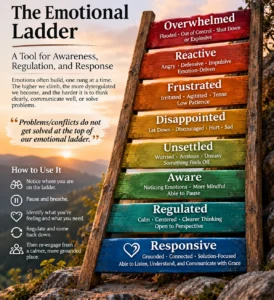
This is where I like to introduce a concept I call Emotional Ladders.
Understanding the Emotional Ladder
Imagine a ladder with a heart at its base and a person standing at the top. The heart represents the place where connection, understanding, empathy, and our intentions reside. As we move higher up the ladder, our emotional state becomes increasingly dysregulated.
The higher we climb, the more likely our emotions are to influence our thoughts, interpretations, and behaviors. We may become defensive, frustrated, reactive, overwhelmed, or focused on protecting ourselves rather than understanding the person in front of us.
In relationships, this can create a particularly difficult dynamic. Two people can begin a conversation with good intentions, but as emotions escalate, both can find themselves further away from the very connection they were hoping to maintain.
One statement I frequently use is:
“Problems/conflicts do not get solved at the top of our emotional ladder.”
Think about that for a moment. When we’re emotionally elevated, our ability to listen, consider another perspective, communicate thoughtfully, and work toward a solution can become increasingly difficult.
We may still be talking, but that doesn’t necessarily mean we’re communicating.
The objective isn’t to eliminate emotions or prevent ourselves from becoming upset. Emotions are valuable sources of information. They tell us something matters, something hurts, something needs attention, or something may need to change.
The objective is to recognize where we are on the ladder before our emotional state begins dictating our next move.
Before You Climb Higher, Consider Changing the Frame
Something interesting happens when we become emotionally invested in an interaction: We often begin responding not only to what someone said or did, but also to what we believe their actions mean.
For example, if a spouse responds irritably to a question, we might immediately interpret that response as disrespect, rejection, or a lack of consideration. But is that necessarily what was intended?
One question I encourage people to consider is:
“Is this person actually trying to hurt me, or could there be another explanation for what just happened?”
Consider the person’s character, your history together, and the circumstances surrounding the interaction. Could they be overwhelmed, distracted, frustrated about something unrelated, or simply communicating differently than you expected?
This doesn’t mean excusing hurtful behavior, overlooking repeated patterns, or abandoning healthy boundaries. Sometimes people do act with harmful intentions, and those behaviors deserve to be addressed.
However, our first interpretation isn’t always the only interpretation.
Sometimes changing the frame can change where we find ourselves on the emotional ladder.
Consider the difference between thinking, “They don’t care about me,” and thinking, “That response hurt, but I don’t necessarily believe they intended to hurt me.”
The situation hasn’t changed, but the meaning we’ve attached to it has. That difference can create enough emotional space to respond differently.
And this brings us to another equally important question.
What Are My Intentions?
It’s easy to spend considerable time evaluating someone else’s behavior while overlooking our own.
When we’re upset, we might become so focused on what someone else did wrong that we lose sight of what we’re actually hoping to accomplish.
Are we trying to resolve something? Communicate a need? Be understood? Establish a boundary? Or have we shifted into defending ourselves, proving a point, or making the other person feel what we’re feeling?
An important question to ask ourselves is:
“Given where I am emotionally right now, can I formulate a civil response that honors my intentions for myself and for others?”
This is not about sacrificing our needs to keep the peace. It’s about recognizing that how we communicate matters just as much as what we communicate.
We can be angry and still communicate respectfully. We can disagree without being disrespectful. We can establish boundaries without attacking someone else’s character.
If we’re too emotionally elevated to do those things, perhaps the most productive response is to pause and return to the conversation when we’re better positioned to have it.
Emotional regulation isn’t about winning an argument or avoiding difficult conversations. It’s about making sure our behavior reflects the person we actually want to be, even when things are difficult.
Six Ways to Stay Grounded on the Emotional Ladder
Recognizing emotional escalation is important, but awareness becomes much more valuable when we have practical ways to respond. Here are six components of the Emotional Ladder approach that can help us remain connected to ourselves and others.
1. Pause and Breathe
Before responding, take a moment to recognize what you’re experiencing.
Ask yourself:
- What emotions am I feeling right now?
- How intense are these emotions?
- Am I responding to what actually happened, or to what I’m interpreting it to mean?
Sometimes three intentional, deep breaths can create enough space to interrupt an automatic reaction. A pause doesn’t mean ignoring the issue. It means giving yourself an opportunity to approach it more thoughtfully.
2. Seek the Heart
Instead of focusing exclusively on someone’s words, consider the feelings and needs underneath them.
Ask yourself:
“What is their heart in sharing this with me?”
Are they feeling hurt, worried, disconnected, misunderstood, or afraid? What might they be trying to communicate that isn’t coming across clearly?
You can even ask the other person directly whether you’re understanding them correctly.
Seeking the heart doesn’t require agreeing with someone. It requires being willing to understand them.
3. Communicate with Grace
How we express ourselves can either invite connection or create more distance.
Try using statements that communicate your experience without assigning blame.
For example, instead of saying, “You never listen to me,” consider saying, “I feel unheard when I’m trying to explain something important to me, and I’d really like us to slow down and understand each other.”
The goal is not to dilute your feelings or avoid difficult truths. It’s to communicate them in a way that leaves room for the other person to hear you.
4. Use Humor or Gratitude as a Ladder Stabilizer
Sometimes a little perspective can help interrupt emotional escalation.
Appropriate humor, a shared memory, or a moment of gratitude can remind us that the relationship is bigger than the disagreement we’re currently having.
This isn’t about making light of someone’s pain or dismissing a legitimate concern. It’s about recognizing when a moment of warmth or connection might help restore perspective.
Sometimes remembering what we appreciate about someone can help us approach a difficult conversation differently.
5. Practice Active Listening
One of the easiest ways to climb higher on the emotional ladder is to stop listening and start preparing our defense.
We become so focused on what we’re going to say next that we miss what the other person is actually communicating.
Try reflecting back what you’ve heard before responding.
For example:
“So what I’m hearing is that you felt overlooked when that happened. Am I understanding you correctly?”
This simple practice can prevent misunderstandings and communicate something important: Understanding each other matters more than winning the disagreement.
6. Practice Emotional First Aid
Sometimes we reach a point where continuing a conversation is no longer productive.
Recognizing that point is an important skill.
A timeout can provide an opportunity to calm down, collect our thoughts, and regain the perspective necessary to communicate effectively.
However, taking a break shouldn’t become a way to avoid difficult conversations indefinitely. Establish an understanding that you’ll return to the discussion at an agreed-upon time.
Emotional first aid isn’t walking away from the relationship or the problem. It’s recognizing that sometimes we need to take care of our emotional state before we can meaningfully address either.
The Goal Isn’t to Stop Feeling. It’s to Respond Differently.
Emotional awareness isn’t about controlling every feeling, avoiding conflict, or pretending something doesn’t bother us.
It’s about recognizing what’s happening internally so we have more choice about what happens externally.
We won’t always interpret situations correctly. We won’t always respond perfectly. And there will certainly be times when someone else’s behavior genuinely warrants a difficult conversation or a firm boundary.
But we can become more intentional about how we approach those moments.
We can learn to recognize when we’re climbing the ladder, question the assumptions contributing to our emotional response, consider the intentions of others, and examine whether our own responses reflect what we genuinely want to accomplish.
Sometimes that means taking a breath. Sometimes it means asking another question instead of making an assumption. Sometimes it means acknowledging that we’re too upset to continue productively.
And sometimes it means recognizing that we can be right about an issue and still approach it in the wrong way.
Ultimately, meaningful connection requires more than expressing ourselves. It requires being willing to understand ourselves and the people around us.
The next time you find yourself in a difficult interaction, consider asking:
- Where am I on my emotional ladder right now?
- What might be the other person’s heart or intention?
- What are my intentions?
- Can I respond in a way that honors both myself and the other person?
- Do I need to pause before continuing?
Remember, problems and conflicts rarely get solved at the top of our emotional ladder.
Sometimes the most productive thing we can do isn’t to climb higher, speak louder, or make a stronger argument. It’s to find our way back to the heart of what matters.
Matthew Rosenkilde, MS, LPC, BHP, is the founder and Clinical Director of Dynamis Counseling in Mesa, Arizona. His work emphasizes the importance of understanding the whole person, developing meaningful connections, and creating opportunities for lasting change. At Dynamis Counseling, we believe meaningful change begins with understanding ourselves and the experiences that shape how we think, feel, and interact with the world.